LED Dress Buying Guide: What to Look For Before You Invest
The Market Is Flooded. Most of It Is Junk.
Search "LED dress" on any marketplace and you will find hundreds of results ranging from $30 to $3,000. The product photos look similar. The descriptions use the same buzzwords. And yet the actual products behind those listings are so different they might as well be separate categories entirely.
I have been designing and building LED garments since co-founding MakeFashion and launching Lumen Couture. I have seen the inside of cheap imports and high-end custom builds. I have repaired garments from other makers and reverse-engineered products from overseas factories. The differences are not subtle — they are structural.
This guide breaks down what actually matters when evaluating an LED garment, so you can make an informed decision regardless of where you buy.
LED Type and Quality
The LEDs themselves are the most important component, and the area where cheap products cut the most corners.

Individually addressable vs. single-color strips. Cheap LED clothing typically uses single-color LED strips — the entire strip turns on or off as one unit, usually in one color. You might get a remote with a few color options, but every LED on the garment displays the same color at the same time. Individually addressable LEDs (like WS2812B or SK6812 chips) allow each LED to display a different color independently. This is what enables actual patterns, animations, text displays, and reactive lighting. If a listing does not specify "individually addressable" or "programmable pixel," assume it is single-color.
Brightness and color accuracy. Not all LEDs are spectrally equal. Cheap LEDs often have a noticeable blue or green shift in their white, and their reds tend toward orange. Higher-quality LEDs produce accurate RGB values across the spectrum. This matters more than you might think — an LED garment with muddy, inaccurate color looks cheap regardless of the pattern it displays.
LED density. Count matters. A garment with 30 LEDs per meter of strip looks sparse and spotty. At 60 per meter, you get a solid line of light. At 144 per meter, you get true pixel density suitable for images and video. More LEDs means more power consumption and more heat, so there is an engineering tradeoff — but higher density almost always looks better.
Construction and Materials
An LED garment is two products in one: a piece of clothing and an electronic device. Both need to be built well.
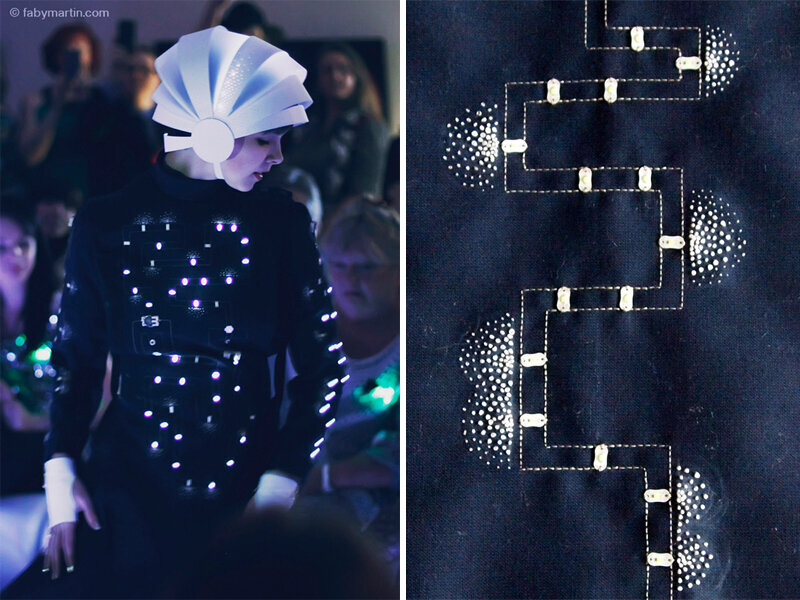
Fabric quality. The cheapest LED dresses use polyester costume fabric — stiff, shiny, and visibly synthetic. It does not drape well, it does not breathe, and it looks like a costume. Fashion-grade LED garments use real textiles: stretch knits, chiffon, sequin mesh, structured cotton blends. The fabric should look and feel like clothing you would actually wear, because it is.
How the LEDs are attached. In budget products, LED strips are often glued or taped to the inside of the fabric. This creates visible hot spots, uneven light distribution, and strips that peel off after a few wears. Better construction involves sewing LED strips into channels, mounting LEDs behind diffusion layers, or integrating them into the fabric structure itself (as we do with our sequin pieces, where each sequin acts as a diffuser for the LED behind it).
Wire management. Lift the garment and look inside. Are the wires neatly routed and secured? Or is it a loose tangle of hookup wire and hot glue? Messy wiring is not just ugly — it is fragile. Loose wires get snagged, pulled, and broken. Every connection point should be strain-relieved.
Featured Product
Dark Power Bodysuit — Constructed with strain-relieved wiring, sewn LED channels, and stretch performance fabric. An example of what built-to-wear LED construction looks like from the inside out. View Product →
Battery and Power
The battery system determines how long you can actually wear the garment and whether it is safe to do so.
Rechargeable vs. disposable. Any serious LED garment should use rechargeable lithium-ion or lithium-polymer batteries. If a product ships with disposable AA or coin-cell batteries, it is a toy. Rechargeable packs deliver consistent voltage, higher current, and dramatically longer runtimes.
Battery life. Ask for a specific number, not a range. "Up to 8 hours" usually means 8 hours at the dimmest setting with a static color. At full brightness running animations, most LED garments draw enough power to run 2–4 hours. That is normal. Anything claiming 10+ hours at full brightness is either using very few LEDs or inflating the number.
Safety certifications. Lithium batteries can be dangerous if poorly manufactured. Look for UL, CE, or UN38.3 certification on the battery. If the seller cannot tell you who manufactured their battery cells, that is a red flag. The batteries we use are tested, certified, and within FAA carry-on limits for air travel.
Replaceability. Batteries degrade over time. A well-designed garment uses a removable, replaceable battery pack — not a battery soldered permanently inside the garment. If the battery dies in a year, you should be able to swap it without sending the entire garment back.
Programmability
This is where the gap between cheap and quality LED clothing is widest.
No programmability means the garment has a fixed set of modes — usually selected by pressing a button on a small inline controller. You get maybe 10–20 patterns: rainbow chase, color fade, strobe. That is it. Forever.
Bluetooth app control means you can connect your phone and select from a larger pattern library, adjust colors, change speed, and sometimes upload custom text or simple images. This is the minimum standard for a garment you plan to wear to different events with different themes.
Full programmability means the garment's controller accepts custom code or animation files. You can create your own patterns from scratch, display images, react to music, or sync with external inputs. This requires more technical knowledge but gives you complete creative control.
Our matrix pieces — the LED Matrix LBD, the matrix belt, the hoodie — use Bluetooth control with a companion app. You get hundreds of built-in patterns plus the ability to display custom text, images, and equalizer-reactive animations. For most people, this is the sweet spot between flexibility and usability.
Featured Product
LED Matrix LBD — Bluetooth-controlled LED matrix panel integrated into a little black dress. Displays custom text, images, and music-reactive animations via companion app. View Product →
Washability and Durability
Here is a question most LED dress listings do not answer: can you wear it more than once?
Cheap LED clothing is often designed for a single event. The adhesive holding the strips fails after a few wears. The wire connections loosen. The battery drains and is not replaceable. It is disposable fashion with a light-up gimmick.
A garment you can actually own long-term needs to survive repeated wearing, some amount of cleaning, and storage between uses. Ask the seller:
- Can it be spot cleaned? (The answer should be yes for any LED garment.)
- Are the electronics removable or protected enough for careful hand washing of the fabric?
- Are replacement parts available — batteries, controllers, individual LED panels?
- Does the company offer repairs?
If the seller cannot answer these questions, the product was not designed with longevity in mind.
Price vs. Value
A $50 LED dress and a $500 LED dress are not the same product at different price points. They are fundamentally different objects built for different purposes.
The $50 dress uses single-color LED strips glued inside a polyester tube dress with a non-rechargeable battery pack. It is designed to be worn once to a Halloween party or a rave, photographed, and thrown away. For that purpose, it works fine.
A $200–$500 garment uses individually addressable LEDs, fashion-grade fabric, sewn and strain-relieved wiring, rechargeable batteries, Bluetooth programmability, and is built by someone who expects you to still be wearing it a year from now. It is designed as clothing first and technology second.
Neither price point is wrong. But confusing one for the other leads to disappointment in both directions — either overpaying for a disposable product, or expecting couture quality at a commodity price.
When evaluating price, break it down:
- LED count and type: Individually addressable LEDs cost 3–5x more than basic strip LEDs.
- Fabric and construction: Fashion-grade materials and hand-sewn integration are time-intensive. A single sequin dress takes hours of careful assembly.
- Electronics: A quality Bluetooth controller, rechargeable battery with protection circuits, and properly routed wiring add real cost.
- Support: Can you email someone who built the garment and get a repair or a replacement part? That infrastructure has value.
What We Build
I started Lumen Couture because the LED garments available at the time were either hacked-together maker projects or overpriced costume pieces. Neither treated the intersection of fashion and technology with the seriousness it deserves.
Every piece in our line uses individually addressable LEDs. The fabric is fashion-grade. The wiring is strain-relieved and routed by hand. The batteries are rechargeable, replaceable, certified, and TSA-compliant. The matrix pieces are Bluetooth programmable. And we answer our own support emails, because we built the things and we know how to fix them.
Our collection ranges from $50 for an LED Matrix Face Mask to $270 for the Starmap Clutch. The sequin dresses, bodysuits, and jumpsuits sit in the $160–$225 range. These are not impulse purchases — they are garments built to last and designed to be worn repeatedly.
If you are evaluating LED clothing from any maker, including us, the criteria above apply equally. Ask about LED type. Look at the construction. Check the battery system. Test the programmability. And decide what you actually need the garment to do.
An informed buyer makes a better decision. That is the point of this guide.