
Is LED Fashion the Future? From Paris Runway to Ready-to-Wear
The Perpetual Future
LED fashion has been "the future" for at least a decade. Every year, a runway show or a Met Gala appearance generates a cycle of headlines declaring that illuminated clothing is about to go mainstream. Every year, the mainstream part does not quite happen. I have been building and selling LED garments since 2017, and I have watched this cycle repeat enough times to have a clear-eyed view of where things actually stand.
The honest answer is complicated. The technology has improved enormously. The cultural appetite is real. But the gap between a concept piece on a Paris runway and a garment you can actually buy, wear, and care for remains wide. Narrowing that gap is the work I do every day, and I want to lay out what is real, what is hype, and what comes next.

The Paris Fashion Week Moment
In early 2025, Anrealage showed LED-embedded dresses at Paris Fashion Week that genuinely stole headlines. The garments changed color under UV light and incorporated electroluminescent panels that created visible pattern shifts on the runway. The collection was technically ambitious, visually striking, and it received the kind of press coverage that most fashion tech projects can only dream of.
It mattered because Paris Fashion Week is the most scrutinized stage in fashion. Showing LED garments there, as a serious collection rather than a novelty stunt, signals that the high fashion establishment is willing to engage with the technology as a legitimate design material. That is a meaningful shift from even five years ago, when illuminated garments at fashion weeks were almost always relegated to the "innovation showcase" category — interesting but not really fashion.
But here is the part that the headlines did not cover: those garments are not for sale. They are concept pieces, produced for a runway show, designed to demonstrate what is possible. That is the role of haute couture — to push boundaries and inspire. It is not the role of haute couture to put products in consumers' closets. The distance between a Paris runway and your actual wardrobe is measured in years and engineering problems, not just price tags.
The Luxury Tier

CuteCircuit has been building LED garments for over twenty years. They have dressed celebrities, created museum installations, and produced some of the most technically sophisticated illuminated clothing ever made. Their work is genuinely impressive, and they have done more than almost anyone to establish LED fashion as a legitimate field.
But CuteCircuit operates at the luxury and bespoke tier. Their garments are custom commissions or special projects, typically priced in the thousands to tens of thousands of dollars. That is appropriate for what they are — handcrafted, technically complex, often one-of-a-kind pieces. The craftsmanship justifies the cost. But it also means that CuteCircuit's work, like the Anrealage runway collection, exists in a space that most people will never access.
This is not a criticism. The luxury tier serves an important function in any design field: it establishes credibility, demonstrates possibility, and creates cultural permission for the technology to exist in fashion at all. Without CuteCircuit's decades of work, brands like mine would face even more skepticism than we already do. But luxury alone does not create an industry. Industries are built in the middle.
The Accessibility Gap
Search for "LED clothing" on any major marketplace and you will find hundreds of results. Most of them cost between ten and forty dollars. Most of them are also disposable. Thin wires glued to polyester. Battery packs that overheat. LEDs that die after a few hours of use. Stitching that unravels the first time you wash the garment — assuming the electronics even survive contact with water, which they usually do not.
This is the accessibility gap in LED fashion. At the bottom, you have cheap novelty products that give people a bad first experience with the technology. At the top, you have bespoke luxury pieces that most people will never encounter. The middle — well-made, actually functional LED garments at a price point a working person can afford — has been almost entirely empty for most of the past decade.
That empty middle is where the real opportunity exists, and it is where Lumen Couture has focused since the beginning.
What Changed

Several material and technology shifts over the past five years have made mid-market LED fashion actually viable in a way it was not before.
LEDs got smaller, brighter, and cheaper. The individually addressable LED strips I use today are a fraction of the cost and size of what was available when I started. Pixel density has increased, which means smoother animations and more vivid color rendering in a smaller physical footprint. The price per LED has dropped enough to make garments economically feasible at a two-hundred-dollar price point rather than a two-thousand-dollar one.
Batteries got smaller and more energy-dense. Lithium polymer cells that would have weighed twice as much five years ago now fit comfortably in a garment pocket. Run times have extended. Charge times have shortened. The battery is still the single heaviest component in any LED garment, but it is no longer a dealbreaker for wearability.
Flexible circuit materials improved. Conductive threads, flexible PCBs, and soft circuit techniques have matured significantly. This matters because the fundamental challenge of LED clothing is that electronics are rigid and bodies are not. Every improvement in flexible circuit materials translates directly to garments that move better, last longer, and feel more like actual clothing.
Bluetooth microcontrollers became trivially cheap. The controllers that drive our LED panels — handling Bluetooth communication, pattern storage, animation rendering — cost a few dollars per unit. That was not true a decade ago. Inexpensive, reliable wireless control is what makes features like smartphone app integration and custom pattern uploads possible at consumer price points.
The Ready-to-Wear Reality
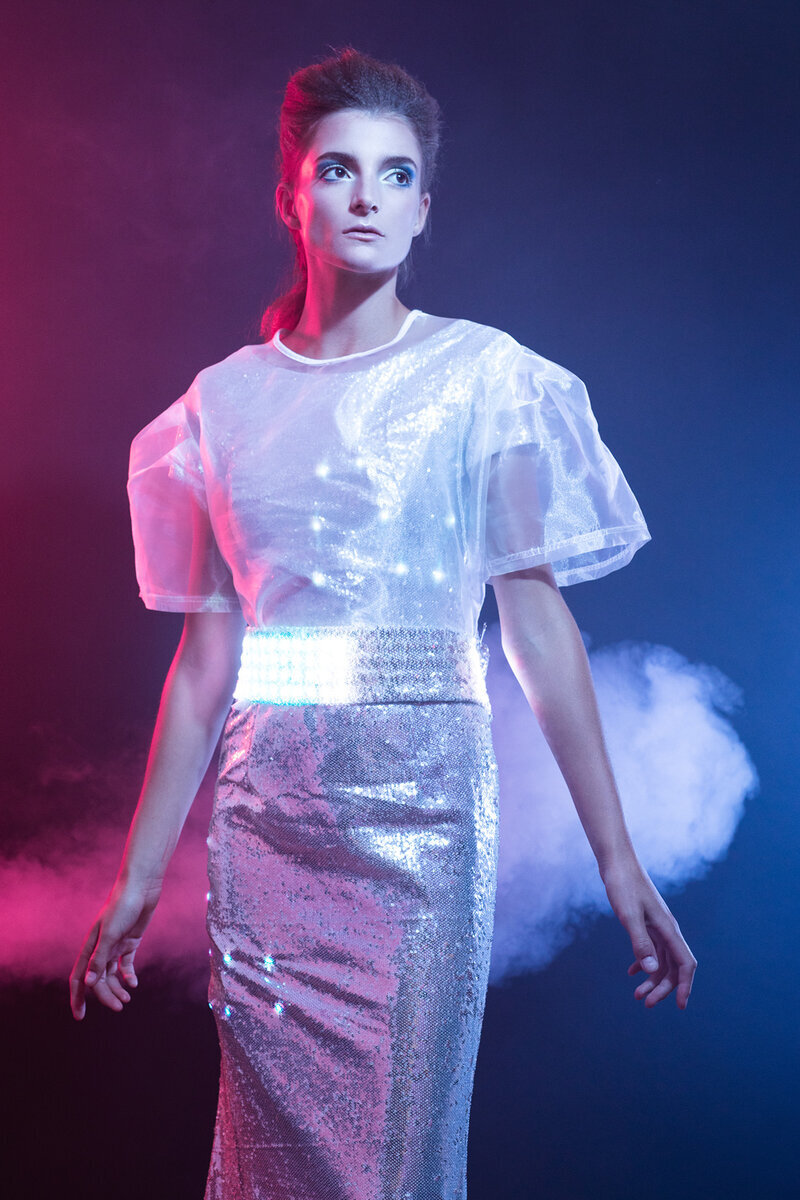
Lumen Couture exists specifically in the gap between cheap novelty and unattainable luxury. Every garment in our line is a real, wearable piece of clothing — not a concept, not a prototype, not a one-off. You can buy it from our website today. It ships to your door. You wear it, control it with your phone, and it works.
Our price range runs from fifty dollars for an LED Matrix Face Mask to two hundred and seventy dollars for the Starmap Clutch. The core of the line — dresses, bodysuits, hoodies, jumpsuits — sits between one hundred eighty and two hundred twenty-five dollars. That is not cheap. But it is the price of a well-made garment with integrated electronics that actually function reliably.
I build these with my hands. I know where every wire runs, how every connection is reinforced, and what each garment can survive. That is not scalable in the way fast fashion is scalable, and I am not pretending otherwise. But it is real, and it is available, and it works. That distinction matters more than people realize when the alternative is either a fifteen-dollar Amazon costume that breaks on first wear or a ten-thousand-dollar couture piece that exists only in photographs.
Featured Product
Browse the full Lumen Couture collection — LED dresses, bodysuits, hoodies, accessories, and more. Real garments, actually purchasable. View Collection →
What Is Still Missing
I am not going to pretend the problems are solved. They are not. LED fashion faces real obstacles that no amount of runway coverage will fix on its own.
Mass production is hard. Traditional garment manufacturing is built around fabric, thread, and standardized construction processes. Adding electronics means adding a second manufacturing discipline on top of the first. Every garment requires electrical testing, firmware loading, and quality assurance steps that do not exist in conventional fashion production. Scaling this is an engineering and logistics challenge that nobody has fully solved yet, including me.
Consumer education is still early. Most people have never owned a garment with electronics in it. They do not know how to care for it, what to expect from battery life, or how to troubleshoot basic issues. Every garment we ship includes an owner's guide, and we provide direct support. But the broader market lacks the baseline familiarity that would make LED clothing feel normal rather than exotic.
Care and maintenance remain friction points. You cannot throw an LED garment in a washing machine. Most of our pieces should be spot-cleaned only. But the care requirements are different from conventional clothing, and that is a real barrier for many potential customers. Until someone develops truly wash-proof integrated electronics at a consumer price point — and that day is coming, but it is not here yet — care will remain a consideration.
Durability perceptions lag reality. Because most people's experience with LED clothing is the cheap stuff — the fifteen-dollar novelty that breaks immediately — there is a default assumption that all LED clothing is fragile. Overcoming that perception requires direct experience, which is a chicken-and-egg problem. People will not buy what they assume will break, and they cannot discover otherwise without buying.
Where This Goes
I have been building in this space for over eight years. Here is what I think happens next.
Within the next three to five years, at least one major fast-fashion or athletic brand will release a consumer LED garment line. It will probably be an accessory first — a bag, a hat, a jacket — rather than a dress. It will be priced between seventy-five and one hundred fifty dollars. It will sell in the millions. And it will be the moment that LED clothing stops being "the future" and starts being just clothing.
The enabling technology is already there. What is missing is the supply chain integration and the corporate willingness to take the risk. The Anrealage show, and the press it generated, moved the needle on that willingness. Every headline about LED fashion on a Paris runway is another data point for the product managers at major brands who are evaluating whether the market is ready.
For Lumen Couture, the path forward is the same as it has always been: build real garments that real people can buy and wear. When the major brands enter this space — and they will — the market will not shrink. It will expand. More people wearing LED clothing means more people understanding LED clothing, and that benefits everyone who builds in this space.
The future of LED fashion is not a single moment. It is not a runway show or a product launch or a celebrity endorsement. It is the slow, unglamorous accumulation of people putting on garments that light up and discovering that it works, it lasts, and it feels good. That process has been underway for years. It is accelerating. And I intend to keep building through all of it.