
MakeFashion: Inside the World's Largest Fashion Technology Runway
MakeFashion is the world's largest wearable technology fashion show. It is a runway production, a design incubator, and an education platform, and I co-founded it. Over the past decade, MakeFashion has staged more than 60 events across 6 continents, showcasing over 250 garments that integrate electronics, lighting, sensors, and code into wearable designs. It is the organization that taught me how to build illuminated clothing at scale, and it is directly responsible for the fact that Lumen Couture exists.
This is the story of how it started, what happens at a MakeFashion show, and why fashion technology events are more relevant now than ever.
The Origin Story
MakeFashion began as an experiment. The premise was simple: what happens when you put fashion designers and electronics engineers in the same room and give them a deadline? The answer turned out to be more interesting than anyone expected.
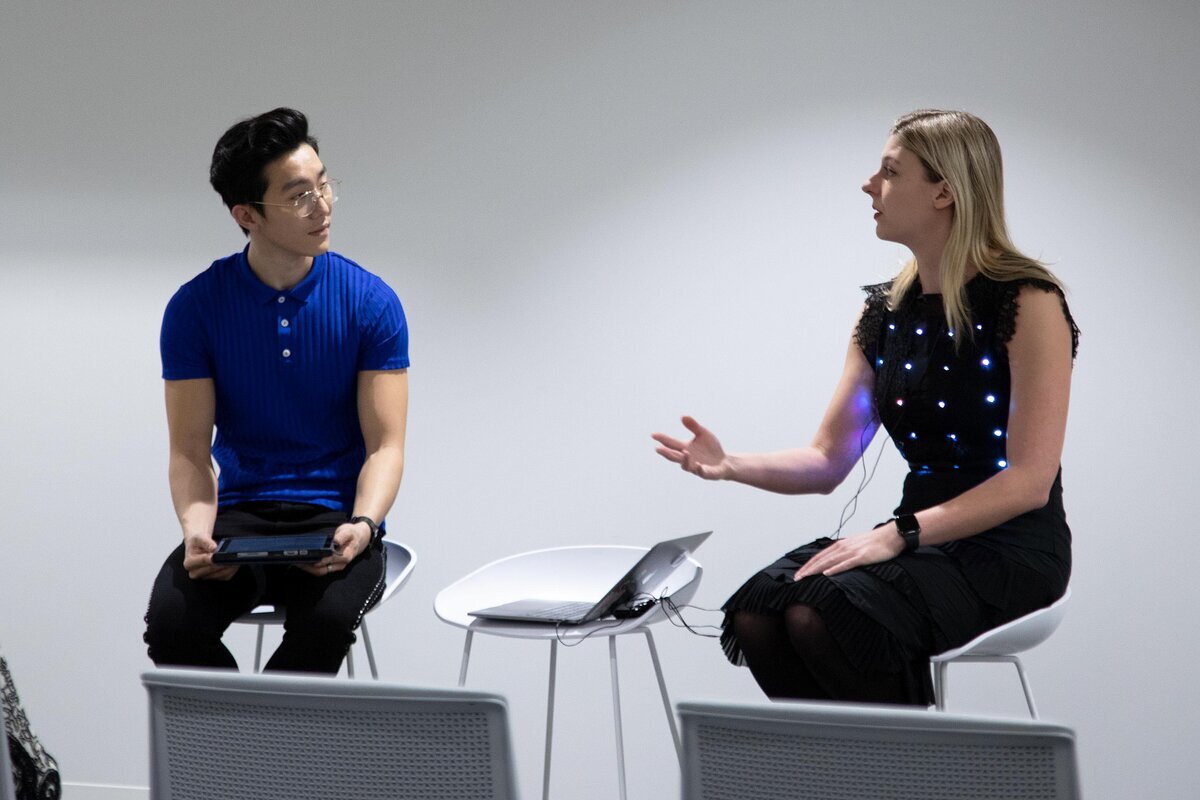
The first show took place in Calgary, Canada. We paired designers who had never touched a microcontroller with engineers who had never sewn a seam. Each team had weeks to build a garment that would walk a runway in front of a live audience. The constraints were real: the garment had to be wearable, it had to survive a walk down a catwalk, and it had to look like something a designer would actually stand behind. No science-fair aesthetics. No exposed breadboards duct-taped to a dress.
That first show proved something I had suspected but could not articulate until I saw it happen: the collision between fashion craft and electronics engineering produces results that neither discipline achieves alone. Designers brought material intuition, color sense, and an understanding of how fabric moves on a body. Engineers brought power management, sensor integration, and code. The garments that emerged were better than anything either group would have built independently.
By the Numbers

The numbers accumulated faster than we anticipated. More than 60 events to date. Six continents. Over 250 individual garments have walked a MakeFashion runway. The shows have taken place in venues ranging from convention centers and theaters to art galleries and outdoor festival stages. We have presented in North America, Europe, Asia, South America, Africa, and Australia.
Each event involves teams of designers and technologists working together under production conditions. These are not academic demonstrations. They are fashion shows with professional lighting, choreography, music, and an audience expecting a spectacle. The garments have to work. They have to light up on cue, respond to sensors, change color, animate. And they have to do all of this while a model is walking, turning, and posing under stage lights. The failure rate on the first show was not zero. It got better.
The Runway Experience
A MakeFashion runway show is not a typical fashion presentation. The house lights drop. The venue goes dark. And then the first model walks out, and whatever she is wearing is producing its own light.


The effect is unlike any other fashion event I have attended or produced. In a conventional runway show, garments are lit by overhead rigs and stage spots. The designer controls the silhouette and the fabric. The lighting designer controls everything else. In a MakeFashion show, the garment is the light source. It defines its own visual presence. A gown with fiber optics woven through tulle creates a halo effect that no spotlight can replicate. A jacket with embedded LED matrices displays animations that move with the model's stride. A headpiece with proximity sensors shifts color as the audience leans closer.
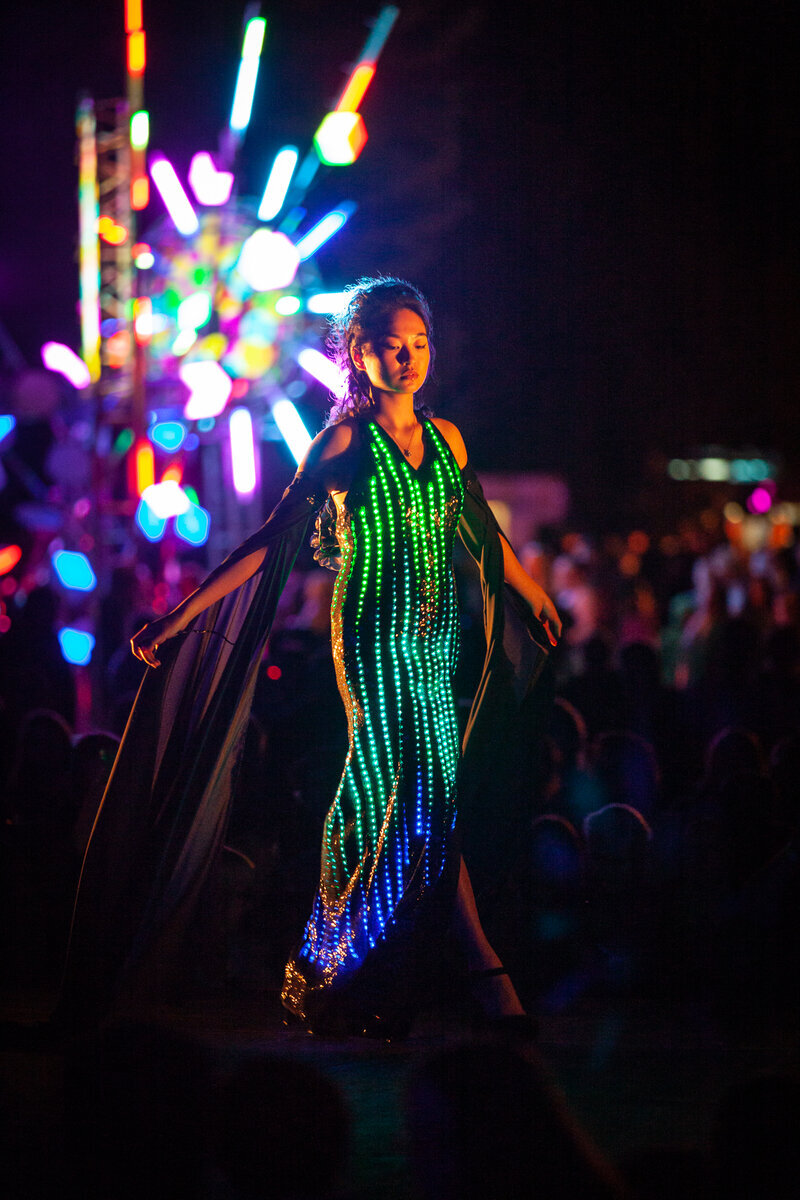

The audience response at these shows is different, too. Fashion audiences are typically reserved. They observe, they take notes, they nod. MakeFashion audiences gasp. They reach for their phones. They applaud mid-walk. The technology creates an emotional immediacy that static garments rarely achieve. It is not about spectacle for its own sake. It is about the fact that light on a moving body is fundamentally arresting to the human eye. We are wired to look at it.
From Runway to Ready-to-Wear
MakeFashion is where I learned what works and what does not. The runway is a testing ground. Every show taught me something about how electronics behave under stress, how batteries perform over the duration of an event, how solder joints hold up when fabric flexes, and how models interact with controls they have never used before.

Those lessons became the foundation of Lumen Couture. Every product in the current collection exists because a version of it was tested on a MakeFashion runway first. The LED matrix technology that powers the Matrix Belt, the Matrix Choker, and the LED Matrix LBD was refined across multiple show seasons. The battery placement, the wiring routes, the connector types, the brightness levels at various distances from an audience: all of this was worked out through live performance before it ever became a product someone could buy online.
The jump from runway prototype to ready-to-wear product is substantial. A runway piece needs to survive one walk. A product needs to survive hundreds of wears, shipping, customer handling, washing around the electronics, and years of battery cycles. MakeFashion gave me the design data to make that jump. Without those 60+ shows, the product line would not exist in its current form.
Featured Product
The Lumen Couture Collection — Every piece in the ready-to-wear line was born from MakeFashion runway testing. LED dresses, bodysuits, accessories, and more. View the Collection →
STEM Education

The runway shows get the press, but the education work is where MakeFashion's long-term impact lives. We run workshops that teach youth to build wearable technology using the same tools and techniques we use for the runway. Soldering irons, LEDs, conductive thread, microcontrollers, needle and thread. The workshops are hands-on from the first minute.
The approach works because fashion is a hook that reaches students who would never sign up for a robotics class. A fourteen-year-old who has no interest in circuit boards will spend three hours learning to solder if the end result is a bracelet that lights up. The electronics knowledge is identical. The entry point is different. And the retention is measurably higher because the output is something they want to wear, show their friends, and keep.
We have run these workshops on multiple continents, in schools, libraries, maker spaces, and community centers. The demographics consistently skew toward participants who are underrepresented in traditional STEM programs. That is not accidental. Fashion technology is one of the most effective bridges between creative disciplines and technical skills that I have encountered in over a decade of working at this intersection.
The Community
MakeFashion is not a company with employees producing garments. It is a network. Designers, engineers, performers, fabricators, photographers, models, and producers contribute to each show. Some are professionals with decades of experience. Some are students participating for the first time. The common thread is that every person in the network believes fashion and technology belong together, and each one brings a skill the others need.
The designer-engineer pairing model is central to how MakeFashion works. A fashion designer brings a vision for a garment. An engineer figures out how to make it glow, move, or respond. Neither can execute the full vision alone. The collaboration is not optional. It is structural. And it produces results that are consistently more ambitious than what either person would attempt independently. I have watched engineers learn to drape fabric. I have watched designers learn to read wiring diagrams. The cross-pollination is real and it is permanent. People leave MakeFashion with skills they did not have before.
What's Next
Fashion technology is not slowing down. The materials keep improving. Flexible LED panels are thinner and brighter than they were five years ago. Microcontrollers are smaller. Batteries are lighter. Bluetooth connectivity has made app-controlled garments accessible to people who have never written a line of code. The tools that used to require an engineering background are now consumer products.
MakeFashion's role is evolving alongside this. The early shows were about proving that fashion and technology could coexist on a runway. That question is settled. The current work is about expanding who participates, reaching new geographies, and continuing to push the design language forward. The workshops are scaling. The runway shows are expanding to new cities. And the community of designers and engineers working in this space is larger than it has ever been.
For Lumen Couture specifically, MakeFashion remains the testing ground. New product concepts still debut on the runway before they reach the production line. The feedback loop between a live audience and a designer standing backstage watching a model walk is irreplaceable. No amount of lab testing substitutes for the moment when a garment meets a crowd. That is where you learn if something works.
If you want to see what fashion technology looks like in person, attend a MakeFashion show. If you want to wear it, the Lumen Couture collection is ready. Every piece in it started under stage lights.