The Technology Behind LED Fashion: How We Build Garments That Glow
Most People See the Glow. This Is What Makes It Work.
When someone sees one of our garments for the first time, they ask two questions: "How does it light up?" and "Can you wash it?" Fair questions. The light is what draws people in, but the engineering underneath is what separates a garment you can actually wear from a science project that falls apart after one outing.
I have spent years developing the construction methods behind Lumen Couture. Every piece involves decisions about LED type, circuit routing, power management, fabric compatibility, and durability testing. This article walks through the core technology choices and why they matter. If you have ever wondered what goes into building clothing that glows, this is the breakdown.
LED Types We Use
Not all LEDs are the same. The type of LED determines everything downstream: brightness, color capability, power draw, flexibility, and how the garment can be controlled. We work with three primary types across the collection.
Individually addressable RGB LEDs. These are the workhorses of the line. Each LED contains a tiny integrated circuit that accepts data signals, which means every single LED can display a different color at any given moment. When you see scrolling text on a Matrix Belt or animated patterns on a Matrix Hoodie, that is individually addressable LEDs at work. We use WS2812B-compatible chips on flexible PCB strips. They run on 5V DC, draw approximately 60mA at full white brightness per LED, and can be daisy-chained to any length. The trade-off is power consumption — a panel of 256 LEDs at full brightness draws meaningful current, which is why power management matters so much.
Flexible LED matrix panels. These are dense grids of individually addressable LEDs mounted on a flexible substrate. The Matrix collection — the LBD, the hoodie, the belt, the bag — all use these panels. The flexibility is critical. A rigid LED panel would crack the first time someone bent at the waist. Our panels flex to a radius of approximately 5cm without damage, which accommodates the natural movement of the human body in almost every position.
Fiber optics. The Stardust line uses side-emitting fiber optics rather than surface-mount LEDs. Fiber optics emit light along their length, creating a diffused, organic glow that looks nothing like a grid of point lights. We couple bundles of 0.75mm PMMA fibers to high-intensity LED drivers at terminal points, then route the fibers through the fabric. The result is that starfield effect — hundreds of tiny points of light distributed across the surface of the garment with no visible circuit board or wiring.
Power Systems
Every LED garment is a portable electronics device, and like any portable electronics device, battery life defines the user experience. If the battery dies two hours into a six-hour event, the garment is just clothing. Our power architecture has to balance capacity, weight, safety, and rechargeability.
We use rechargeable lithium-polymer (LiPo) cells. They offer the best energy density for their weight, which matters when the battery has to live inside a garment without pulling it down or creating a visible bulge. Depending on the piece, battery capacity ranges from 2000mAh for accessories like the Choker to 6000mAh for full garments like the hoodie. All packs include integrated protection circuits for over-charge, over-discharge, and short-circuit conditions. Safety is non-negotiable when electronics sit against skin.
Power management is handled by a microcontroller that regulates brightness based on the active pattern. A solid white display at maximum brightness draws the most power. An animated pattern that uses 30% of the LEDs at any given time draws significantly less. Our firmware dynamically manages current draw, which is how we achieve four to six hours of run time on patterns that would theoretically drain the battery in two hours at full blast.
Charging is via standard USB-C. The battery packs are removable on most pieces, which means you can swap in a fresh battery mid-event if you have a spare, or charge the pack separately while wearing the garment with a different pack. We made this decision early and it has proven to be one of the most practical design choices in the line.
Circuit Integration

This is the hardest part. Electronics are rigid. Fabric is not. The challenge is embedding circuits into a garment without destroying the drape, the comfort, or the aesthetic.
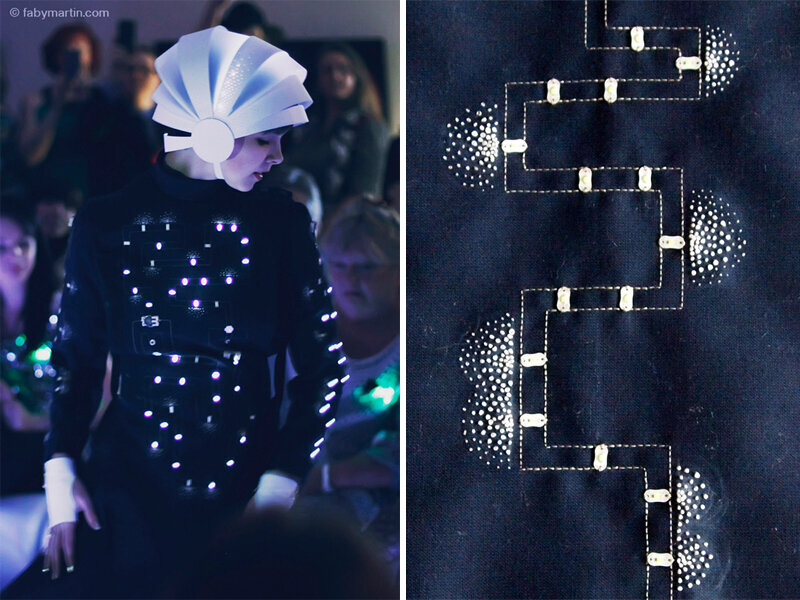
The approach depends on the garment. For the Matrix collection, the LED panels are mounted in channels sewn into the fabric. The channels hold the panels in position while allowing them to flex with body movement. Power and data wires route through fabric tubes — essentially reinforced seams — from the panel to the controller and battery, which sit in an interior pocket. From the outside, you see the light. You do not see the wiring.
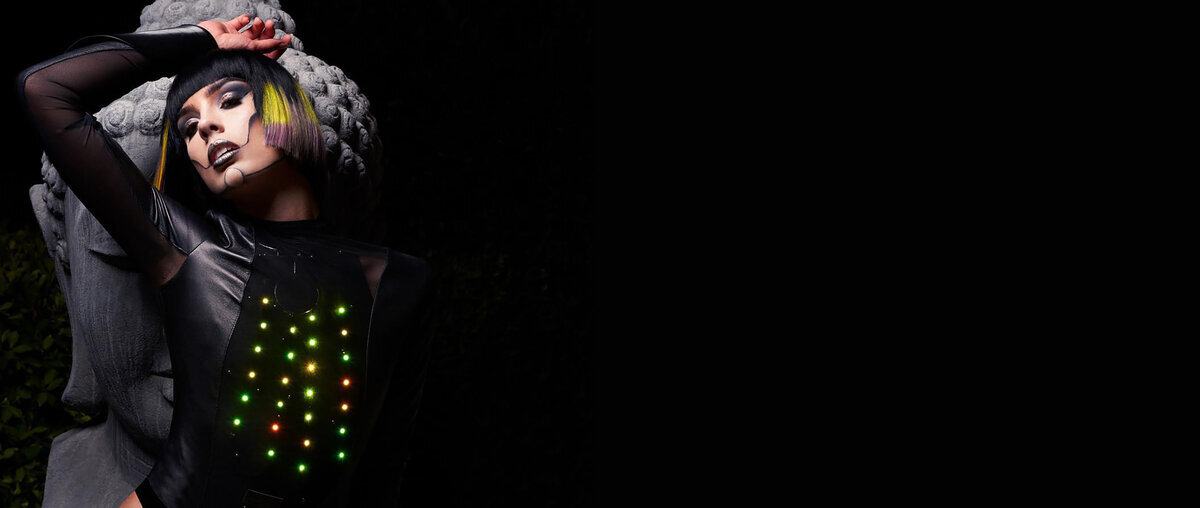
For the Dark Power Bodysuit, the approach is different. The LEDs trace lines across the body in specific geometric patterns. Each line is a flexible LED strip bonded to a thin silicone backing, then stitched into place between fabric layers. The bodysuit is close-fitting, so every component has to follow the body's contours precisely. I pattern-draft each circuit path on a dress form before cutting a single piece of fabric. The electronics layout is as much a part of the pattern as the fabric panels.
Featured Product
Dark Power Bodysuit — $160. Individually addressable RGB LEDs in geometric circuit paths, close-fitting construction with integrated power management. A study in circuit-to-garment integration. View Product →
The Fabric Question
Fabric selection is constrained by the electronics, not the other way around. I cannot use any fabric I want. The material has to meet specific criteria: it has to be opaque enough to hide wiring but positioned to let light through where the LEDs sit. It has to be strong enough to support the weight of components without stretching out. It has to handle heat dissipation — LEDs generate warmth, and that warmth has to go somewhere.

For the sequin pieces, we use sequin fabric as both a decorative element and a light diffusion layer. Sequins are reflective, which means LEDs positioned behind them create a scattered, multidirectional glow rather than a single point of light. The effect is closer to how light behaves on water than how it behaves on a screen. The fabric is mounted on a stretch mesh backing that provides structure and allows the garment to move with the body.
For the Matrix pieces, we use a technical mesh with a specific denier and opacity that allows the LED matrix to be visible while maintaining a clean surface appearance when the lights are off. Finding that fabric took months of testing. Too sheer and you see the circuit board. Too opaque and the light is muted. The material we settled on is a polyester-spandex blend with a matte finish that hits the right balance.
Structured garments like the bodysuit use a heavier ponte knit that provides compression and holds circuit channels in position. Flowing garments need lighter fabrics, which means lighter electronics and more creative routing. Every garment type is a different engineering problem.
Programming and Control
Every piece in the current collection connects to a smartphone via Bluetooth Low Energy (BLE). The companion app lets you select from pre-loaded patterns, adjust brightness and speed, set colors, and in some cases upload custom text or images. The microcontroller in each garment runs firmware that handles BLE communication, pattern generation, and LED driving simultaneously.
Pre-loaded patterns are stored in flash memory on the controller. This is important because it means the garment works without a phone connection. You pair once, select your pattern, and it runs independently. Your phone can go in your pocket or your bag. The BLE connection is only needed to change settings. At a festival or event, this matters — you do not want to be staring at your phone to keep your outfit running.
For the Matrix pieces, the controller drives the panel at a refresh rate high enough that animations appear smooth to the eye and to cameras. This matters more than people realize. A slow refresh rate causes visible flicker in photos and video. Our panels refresh at rates that eliminate banding in smartphone cameras, which means your outfit photographs the way it looks in person.
Featured Product
LED Matrix LBD — $225. Programmable flexible LED matrix panel integrated into a little black dress silhouette. Bluetooth app control, pre-loaded patterns, custom text and image upload. View Product →
Care
This is the question everyone asks, and the answer determines whether LED fashion is a novelty or a real product category. If you cannot maintain a garment, it is a costume. We build our pieces to survive real-world wear.
Most of our garments should be spot-cleaned only. Power off and disconnect the battery before treating any stains, and ensure the garment is fully dry before turning it back on. Some items, like the Sequin Collection, have removable washable linings — see the Owner's Guide for garment-specific care instructions.
We do not recommend machine washing or dry cleaning. These constraints are real, but they are not onerous for the kind of garments these are. Careful spot treatment handles most real-world wear situations.
From Prototype to Product

A new garment starts as a sketch, but it becomes a product through a process that looks more like hardware development than fashion design. The typical timeline from concept to shippable product is three to six months, depending on complexity.
The first step is always the electronics layout. Before I cut fabric, I need to know where the LEDs go, where the wires route, where the battery sits, and where the controller mounts. I build the circuit on a test form first — a dress form or a flat surface that approximates the garment shape — and verify that every LED lights, every connection holds, and the power budget works. This prototype is ugly. It is wires and tape and clips. But it proves the electronics work.
Next comes the fabric prototype. I drape or pattern-draft the garment around the electronics layout, building in the channels, pockets, and routing paths. This is where fashion design and electrical engineering collide. A seam that looks perfect aesthetically might cross a wire path. A dart that shapes the bodice might pinch a data line. Every pattern piece gets negotiated between how the garment should look and where the electronics need to go.
After the first wearable prototype, we test. The garment goes on a person and gets worn in conditions that simulate real use. Dancing, bending, sitting, raising arms, sweating. We check for hot spots, flickering, wire fatigue, and comfort. Most first prototypes fail at least one test, which sends us back to revise the circuit routing or the fabric construction. Some garments go through four or five revisions before they are ready.
The final step is documentation and production setup. Every garment has an assembly sequence that has to be reproducible. Unlike traditional fashion production, where you cut fabric and sew, our assembly includes soldering, conformal coating, firmware flashing, quality testing of every LED, and a final burn-in test where the garment runs patterns for an extended period to catch infant-mortality failures in components. The garment that ships has been individually tested and verified. Every one.
This process is why LED fashion is not cheap. The materials are specialized, the labor is skilled, and the quality control is intensive. But it is also why our garments work — reliably, repeatedly, in real-world conditions. That is the difference between a product and a prototype, and it is the standard we hold every piece to before it leaves the workshop.